
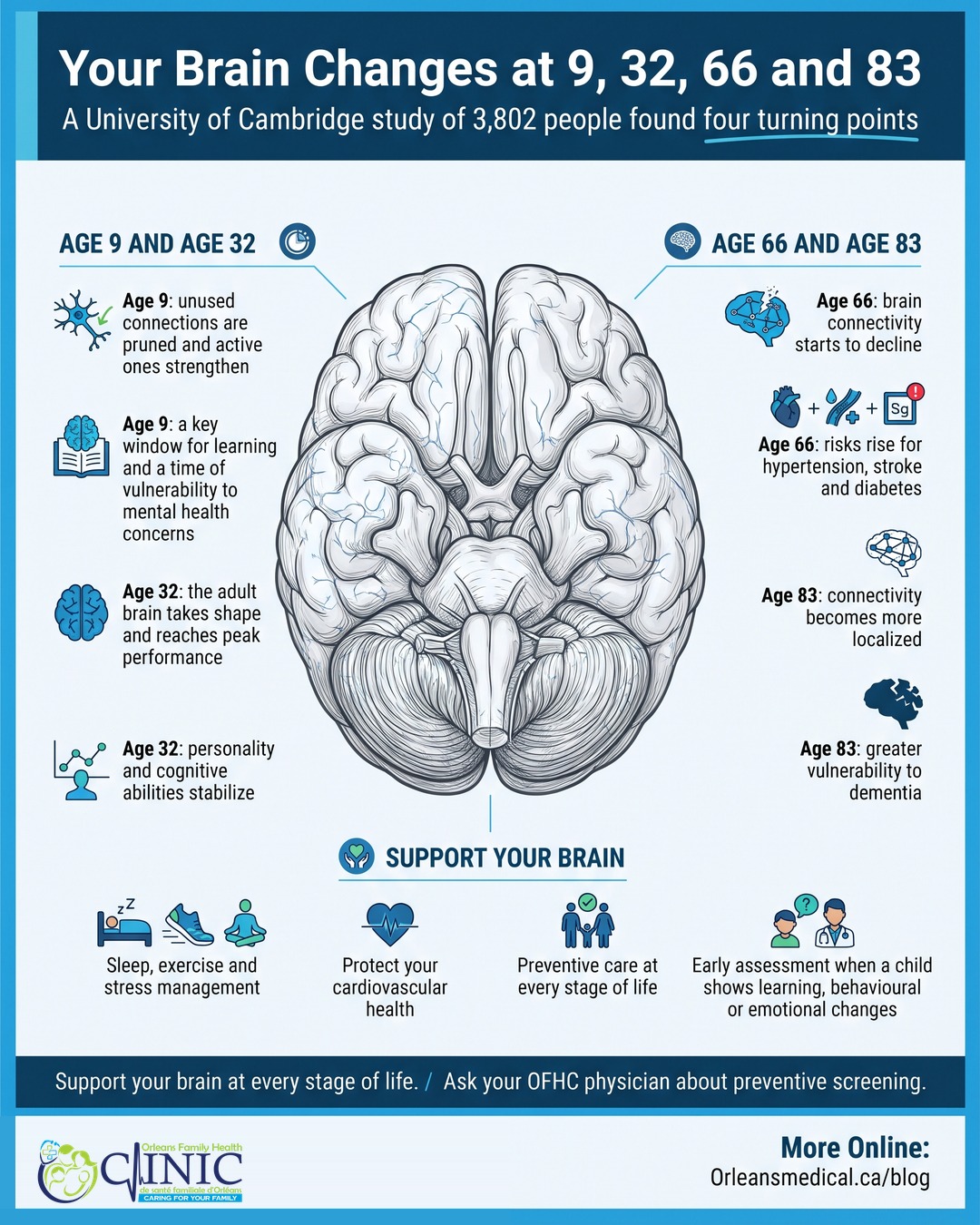
Your Brain Changes at 9, 32, 66, and 83: What New Research Reveals About Lifelong Brain Health
Your Brain Changes at 9, 32, 66, and 83: What New Research Reveals About Lifelong Brain Health
At Orléans Family Health Clinic (OFHC), supporting healthy development and aging is central to our model of Complete, Comprehensive, Caring, Connected Care. A new study from the University of Cambridge—one of the largest brain-mapping projects ever conducted—helps explain how the human brain evolves at key stages of life, and how these changes affect learning, mental health, and cognitive aging.
Published in Nature Communications, the study analyzed MRI diffusion scans from 3,802 people ages 0 to 90, revealing five major phases of brain structure. These phases are separated by four pivotal turning points when the brain reorganizes its neural wiring.
Understanding these transitions can help families, clinicians, and caregivers better support brain health across the lifespan.
The Four Major Turning Points in Brain Architecture
Age 9 — Childhood Brain Architecture
From birth through roughly nine years old, the brain undergoes intense consolidation:
- Babies are born with an overabundance of neural connections (synapses).
- During childhood, unused synapses are pruned while active ones strengthen.
- Both grey matter and white matter grow rapidly.
This developmental window is critical for learning—but also a time of increased vulnerability to mental health concerns.
This explains why OFHC monitors developmental milestones closely and encourages early assessment when a child shows learning, behavioural, or emotional changes. Early intervention matters because the brain is actively reshaping itself.
Age 32 — The Adult Brain Takes Shape
Around the early 30s, the brain enters the most defined shift of the entire lifespan.
According to the researchers, age 32 represents the brain’s “strongest topological turning point.”
What this means:
- White matter continues refining its networks, resulting in peak cognitive performance.
- This marks the true end of adolescence from a neurological perspective.
- Personality traits and cognitive abilities stabilize.
This adult-brain era lasts three decades with no major structural shifts.
For OFHC patients, this is a reminder that lifestyle choices—sleep, exercise, stress management, relationship health, and preventive care—have profound long-term effects on brain stability during this prolonged plateau.
Age 66 — Early Aging Begins
The mid-60s bring gradual but meaningful changes:
- Brain connectivity starts to decline as white matter slowly degenerates.
- Cognitive changes are often subtle.
- Risks increase for conditions like hypertension, stroke, diabetes, and vascular changes that affect cognition.
At OFHC, this is where our proactive senior health screening, fall-risk assessment, and chronic disease management programs become especially important. Small changes in cardiovascular health can greatly influence long-term cognitive outcomes.
Age 83 — Late Aging and Localized Connectivity
The final major turning point appears around age 83, though fewer participants reached this age.
Key observations:
- Brain connectivity becomes more localized rather than global.
- Some regions compensate for others that decline.
- This era is strongly associated with vulnerability to dementia and neurodegenerative disease.
OFHC’s approach emphasizes connected care—coordinating with neurologists, geriatricians, occupational therapists, and caregivers to support independence, memory health, and quality of life.
Why These Brain “Eras” Matter
The study suggests that brain development is not a smooth, continuous curve—rather, it progresses in distinct epochs.
These transitions help explain:
- Why learning challenges often emerge in childhood
- Why cognitive and emotional patterns solidify in adulthood
- Why memory, processing speed, and executive functioning may change in the 60s and 80s
- Why certain neurological conditions cluster at predictable ages
Understanding these eras helps clinicians pinpoint when the brain is most adaptable—and when it is most vulnerable.
At OFHC, integrating this research into practice allows us to better guide patients through each phase of life with preventive screening, personalized health strategies, and physician-supported care.
Stay Connected with Orleans Family Health Clinic!
If you found this article helpful, don’t forget to like, share, and Follow to stay up to date on our latest health tips, updates, and wellness advice.
And follow us on social media
Disclaimer: The medical information on this site is provided as an information resource only and is not to be used or relied on for any diagnostic or treatment purposes. This information does not substitute for professional diagnosis and treatment. Please do not initiate, modify, or discontinue any treatment, medication, or supplement solely based on this information. Always seek the advice of your healthcare provider first. Full Disclaimer.

