
Early Bird or Night Owl? New McGill Research Shows Your Sleep Type May Be More Complex — and More Clinically Relevant — Than You Think
Most people think of sleep patterns in simple terms: you’re either an “early bird” or a “night owl.” But new research from McGill University suggests the science of sleep timing — known as chronotype — is far more nuanced, and those differences may carry meaningful health implications.
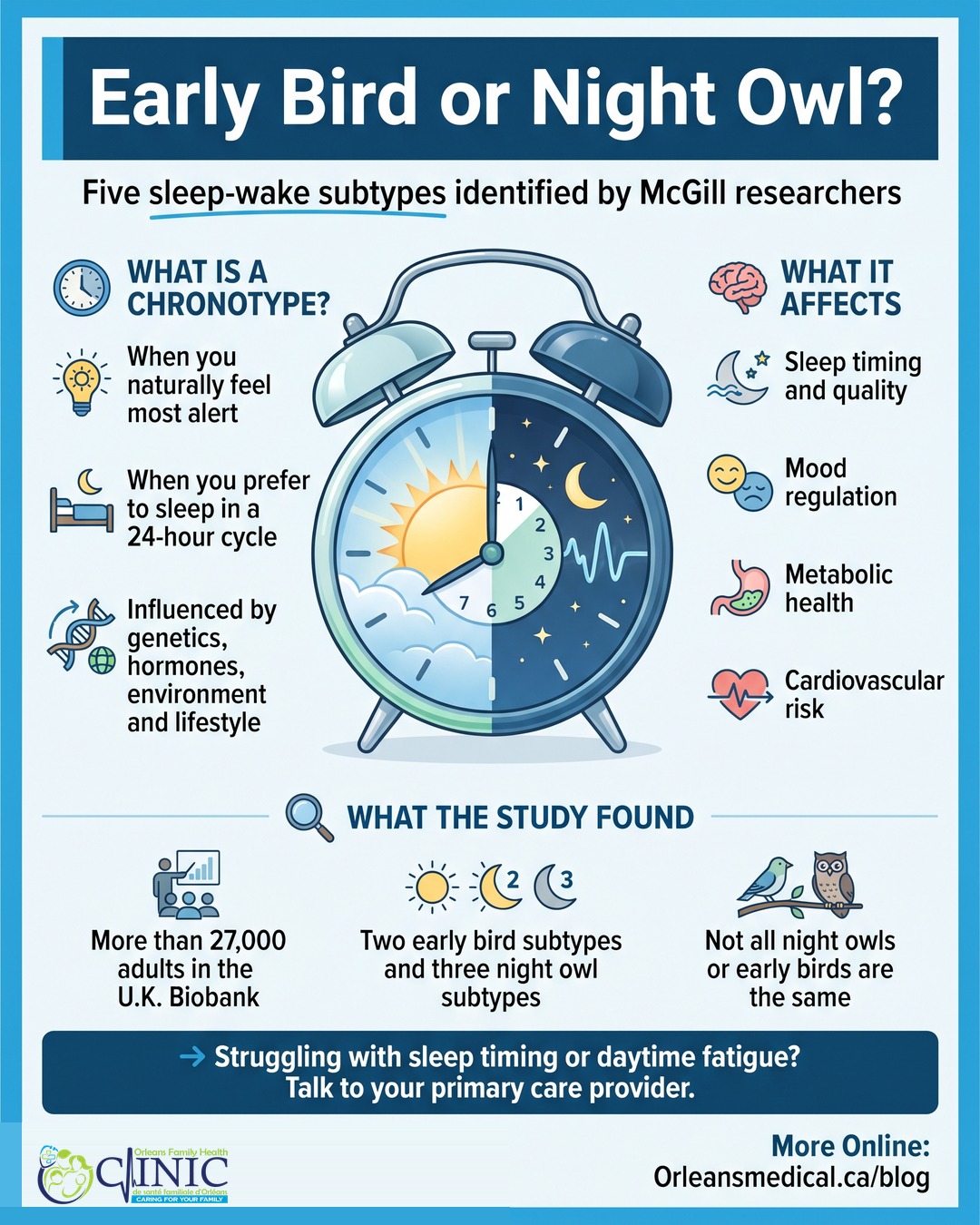
In a large study published in Nature Communications, McGill researchers used artificial intelligence to analyze health and behavior data from more than 27,000 adults in the U.K. Biobank. Instead of just two chronotypes, they identified five distinct biologically defined sleep-wake subtypes, each associated with different behavioral traits and clinical risk patterns.
What Is a Chronotype?
A chronotype describes when a person naturally feels most alert and when they prefer to sleep within a 24-hour cycle. It is influenced by genetics, hormones, environment, and lifestyle. Chronotype affects:
- Sleep timing and quality
- Cognitive performance
- Mood regulation
- Metabolic health
- Cardiovascular risk
Previous research has linked late chronotypes (“night owls”) with higher risks of psychiatric and metabolic disorders — but this new study shows that not all night owls — or early birds — are the same.
Five Distinct Sleep-Wake Subtypes Identified
Researchers found:
Two Early Bird Subtypes
One subtype matched the traditional “healthy early riser” profile:
- Higher education levels
- Lower alcohol use
- Lower risk-taking behavior
- Fewer emotional health concerns
A second early-rising subtype — largely female — showed:
- Higher rates of depressive symptoms
- Greater antidepressant use
- Associations with hormonal factors such as lower testosterone and menstrual irregularities
Three Night Owl Subtypes
One subtype showed:
- Strong problem-solving performance
- Fast reaction time
- Better white-matter brain integrity
But also:
- More emotional regulation challenges
- Higher alcohol and tobacco use
Another subtype was associated with:
- High computer gaming time
- Low physical activity
- Higher cardiovascular risk
- More depressive symptoms
A third, largely male subtype showed:
- Higher testosterone
- More risk-taking behaviors
- Increased alcohol and smoking
- Associations with prostate conditions
- Cardiovascular risk — but fewer depression symptoms
Why This Matters for Primary Care
This research reinforces a core principle of modern primary care: biological and behavioral diversity matters. Sleep patterns are not simply lifestyle choices — they are biologically influenced and clinically relevant.
A one-size-fits-all approach to sleep advice may miss important individual risk factors. Personalized assessment is more effective — especially when sleep patterns intersect with:
- Mental health
- Hormonal health
- Cardiovascular risk
- Medication use
- Lifestyle habits
How OFHC’s Care Model Supports Personalized Health
At Orleans Family Health Clinic, our care model is built around Complete, Comprehensive, Caring, and Connected Care — the 4 C’s. Sleep health is not treated in isolation. It is assessed within the broader context of:
- Mental health screening
- Cardiometabolic risk evaluation
- Medication reviews
- Lifestyle counselling
- Preventive care planning
Because OFHC actively recruits physicians and works closely with our integrated pharmacy and care teams, we are able to roster patients and provide longitudinal, relationship-based primary care — which is essential when addressing complex, individualized health patterns like sleep chronotype.
If you struggle with sleep timing, daytime fatigue, mood changes, or irregular sleep schedules, it is worth discussing with a primary care provider. These patterns can be clinically meaningful — and modifiable with the right guidance.
Stay Connected with Orleans Family Health Clinic!
If you found this article helpful, don’t forget to like, share, and Follow to stay up to date on our latest health tips, updates, and wellness advice.
And follow us on social media
Disclaimer: The medical information on this site is provided as an information resource only and is not to be used or relied on for any diagnostic or treatment purposes. This information does not substitute for professional diagnosis and treatment. Please do not initiate, modify, or discontinue any treatment, medication, or supplement solely based on this information. Always seek the advice of your healthcare provider first. Full Disclaimer.

